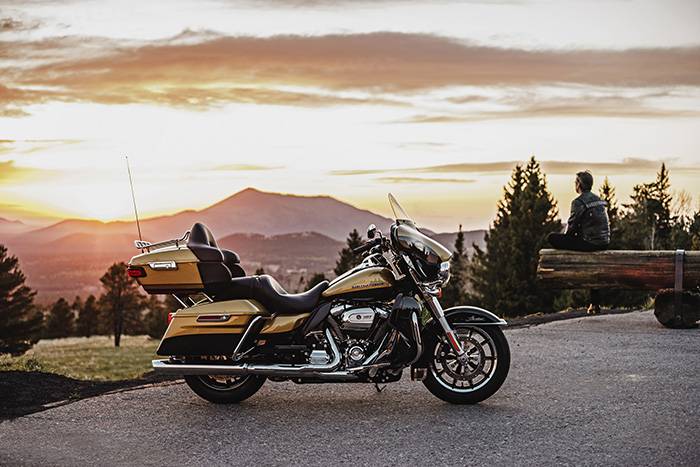
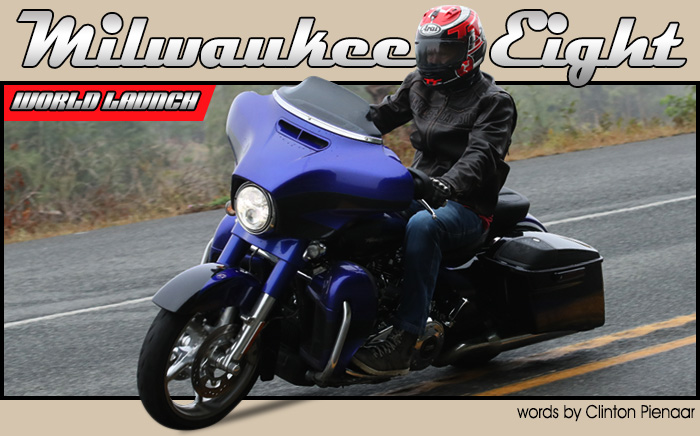
 The Milwaukee-Eight is the new engine in Harley’s stable since the Twin Cam motor which was release in 1999.
This is big news and the entire World’s Harley owners have eagerly been anticipating this new engine for some time now. ‘What do customers want?’ was the driving force behind the design so a few workshops were held to find out exactly what the requirements were and they are as follows;
1. I want more power.
2. I want a cooler thermal ride experience.
3. I want the bike to fit me.
4. I still want the look, feel and SOUND!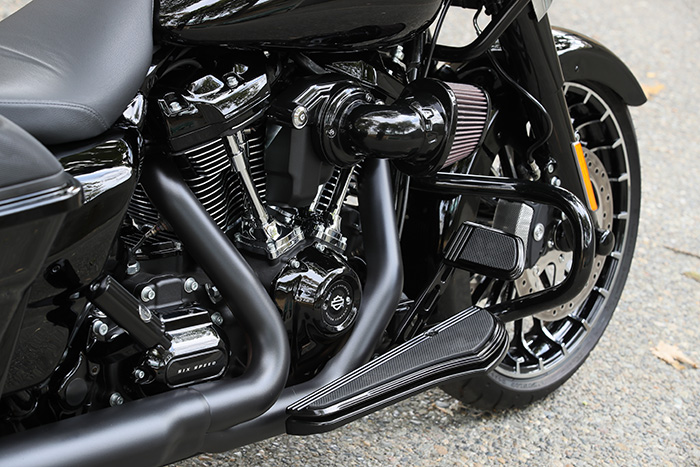
So off to the drawing boards the engineers went and they came up with two motors, the 107 oil-cooled and the 114 water and oil-cooled, both called the Milwaukee-8. What the engineers came up with was an upgraded 8 valve head but the whole design started from a clean sheet. These engines will be introduced firstly in the touring range of motorcycles, so let’s delve a little into the engine itself.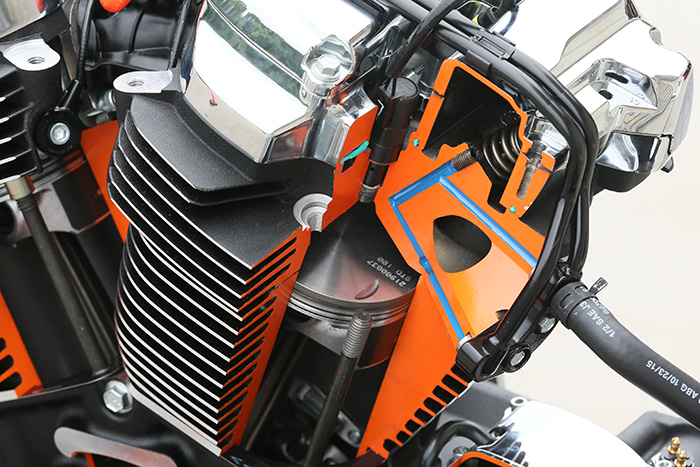
New Milwaukee-Eight Engine
The new Milwaukee-Eight engine is a totally new design that aims to combine the classic look, sound and feel of Harley-Davidson Big Twin engines with improvements in every aspect of engine performance, from power, to heat, to fuel consumption and emissions.
‘The Milwaukee-Eight engine carries the legacy of Harley-Davidson Big Twins into the future,’ said Alex Bozmoski, Harley-Davidson Chief Powertrain Engineer, who led the development team. ‘While respecting the essential Big Twin character, we’ve created an all-new motor. Every aspect of performance, durability and styling has been improved as a direct response to the voice of Harley-Davidson customers around the world.’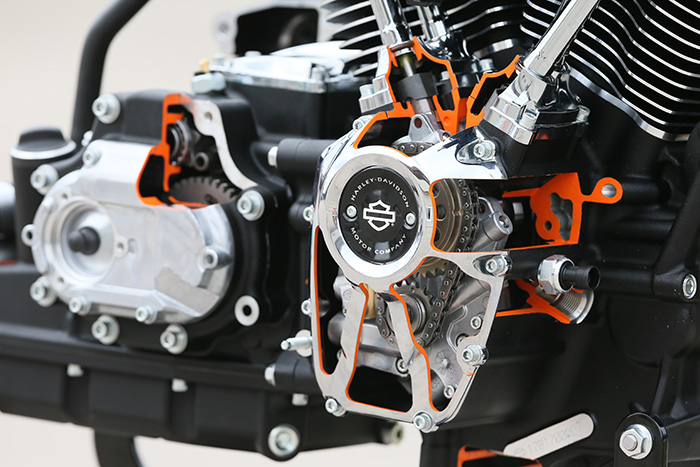
Retaining the classic 45-degree V-Twin cylinder angle, the Milwaukee-Eight engine produces 10 percent more torque than previous year models and features four-valve cylinder heads that offer 50 percent more intake and exhaust flow capacity. The danger with 4 valves per cylinder is that they normally need higher revs to attain the higher performance but Harley countered that by closing off the exhaust valves a little earlier. The Milwaukee-Eight engine is counter-balanced to cancel 75 percent of primary vibration at idle, retaining the feel of a Harley V-Twin while being very smooth at highway speeds. My initial reaction to this was that it was too smooth, I felt they gave into too much advancement but in truth, after my two days on the bike I can actually say, it did sway me towards the newer way. I’ve ridden a 103 since my return and it actually felt fairly agricultural after my Seattle experience with the new engines. 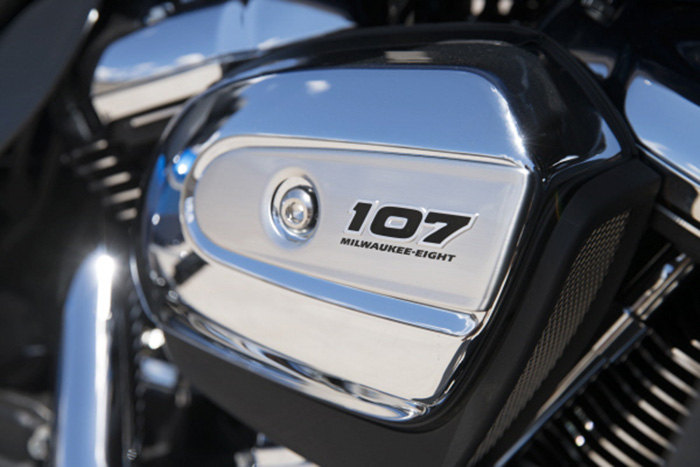
Milwaukee-Eight engines are offered in two displacements; The Milwaukee-Eight 107 (1750cc) featuring oil-cooled cylinder heads for the Street Glide/Street Glide Special, Road Glide/Road Glide Special, Electra Glide Ultra Classic, Road King and Freewheeler models; the Twin-Cooled Milwaukee-Eight 107 (1750cc) with liquid-cooled cylinder heads for the Ultra Limited/Ultra Limited Low, Road Glide Ultra and Tri Glide Ultra models; and the Twin-Cooled Milwaukee-Eight 114 (1870cc) with liquid-cooled cylinder heads for the CVO Limited and CVO Street Glide models.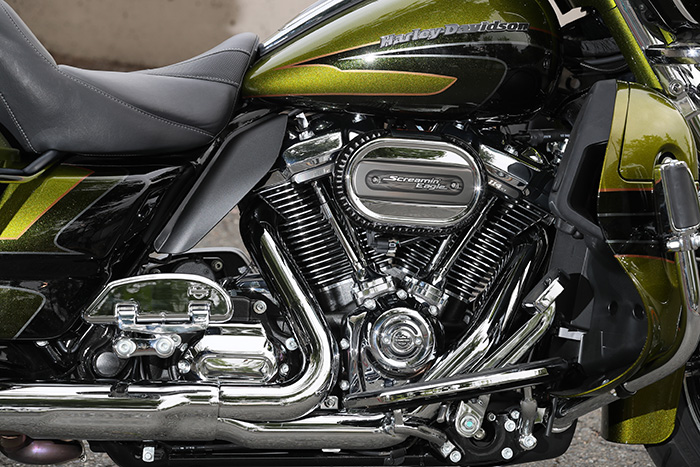
‘These are the most powerful, most responsive and most comfortable touring motorcycles ever offered by Harley-Davidson,’ said Scott Miller, Vice-President of Styling and Product Development Strategy. ‘The unmistakable look, sound and feel of Harley-Davidson Touring motorcycles rise to even greater heights with the improvements we’ve made this year.’
The most obvious change in the power plant is right there in each engine’s model name: Milwaukee-Eight 107 and Milwaukee-Eight 114. The Twin Cam 103 engine grew to 107 cu. in. thanks to its new bore and stroke of 3.937 in. x 4.375 in. (99.999mm x 111.125mm) while the 110 jumped up to 114 cu. in. via its 4.0-in. x 4.5-in. (101.6mm x 114.3mm) bore and stroke. However, the changes go much deeper than having bigger lungs to fill. The four-valve head is said to flow 50% more than the Twin Cam’s – a good thing since the Screamin’ Eagle big-bore kits can bump the displacement to 114 cu. in. and 117 cu. in. respectively.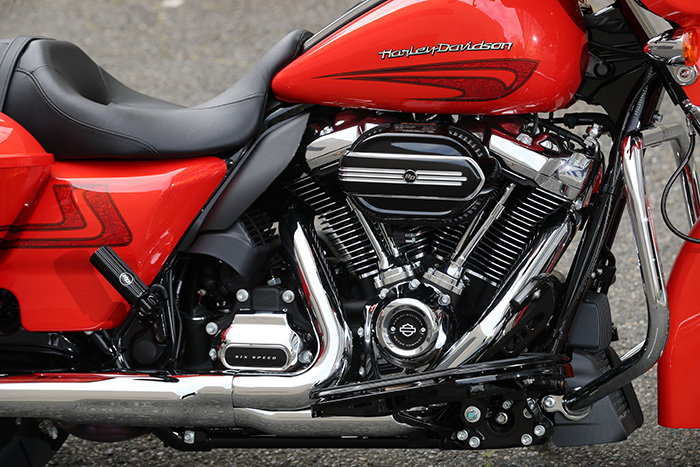
The four-valve head brought its own design considerations into play, the current modelling technology has allowed for the single cam to return, bringing with it multiple advantages: less parasitic power losses, less complexity, and less mechanical noise. The switch to a four-valve head also had other benefits. Smaller valves have lower mass, requiring less spring to close, which results in a lessened impact on the valve seat. This reduced the beating the valve seats take and translates into lessened valve wear and lower noise. But the biggest advantage is that the new system has not got any valve clearance setting adjustments.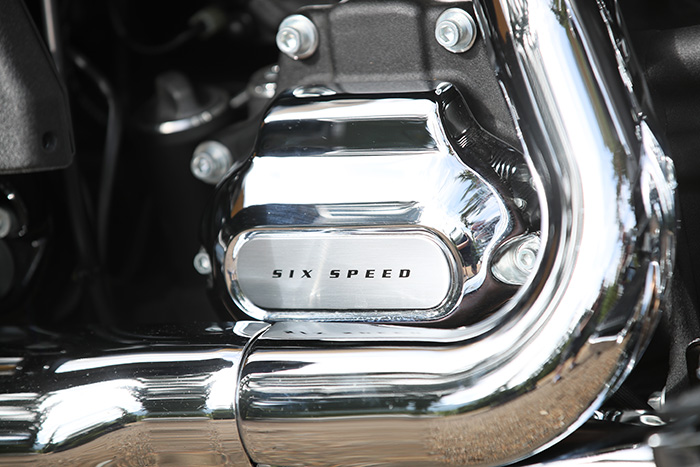
‘The cure was worse than the disease, putting the adjustment in caused you to have more adjustments.’ said Bozmoski, ‘It was the thing that wore the most.’ So, once the valve lash is set at the factory, no adjustment will be required for the life of the engine’. Bozmoski stresses, ‘After one and a half million miles and over 7,000 hours of accelerated dyno durability, you don’t see any of them needing an adjustment. They wear together.’
Feeding the new heads, a new Mikuni throttle body is 5mm bigger, at 55mm, compared to the previous one. The ignition system gained individual knock sensors on each cylinder to dynamically fine-tune the spark timing to deliver optimum power while also reducing the heat produced by the engine. According to Bozmoski, the switch from ion-sensing knock sensors to cylinder-mounted ones dramatically increases the range of individual cylinder spark control the ECU has over the firing of the twin plugs, allowing as much ignition advance as possible. ‘So, you’re not creating heat by retarding the spark to keep yourself away from knock,’ explains Bozmoski.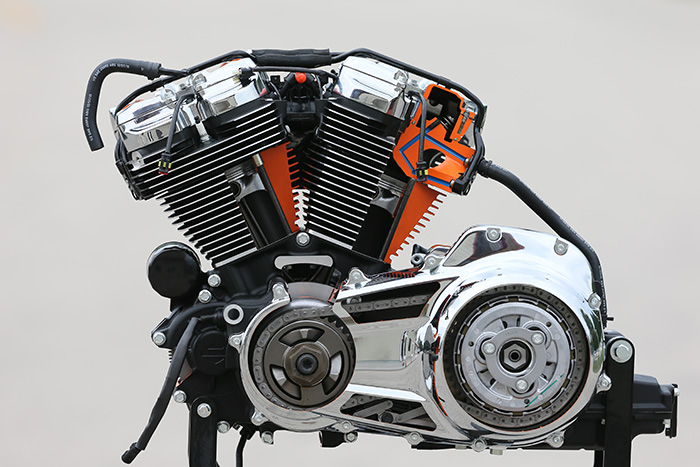
Since knock increases exhaust gas temperature (EGT) and in extreme cases can damage the engine, the Milwaukee-Eight’s ignition timing can be retarded right up to the point of the first signs of predetonation. Managing ignition timing to the ragged edge of detonation delivers not only more power with less heat, but it also burns cleaner for fewer emissions, allowing the largely air-cooled engines to meet the strict Euro 4 standards while delivering within 2-4% of the performance of engines tuned to meet U.S. standards. We get the Euro 4 compliant bikes here in SA.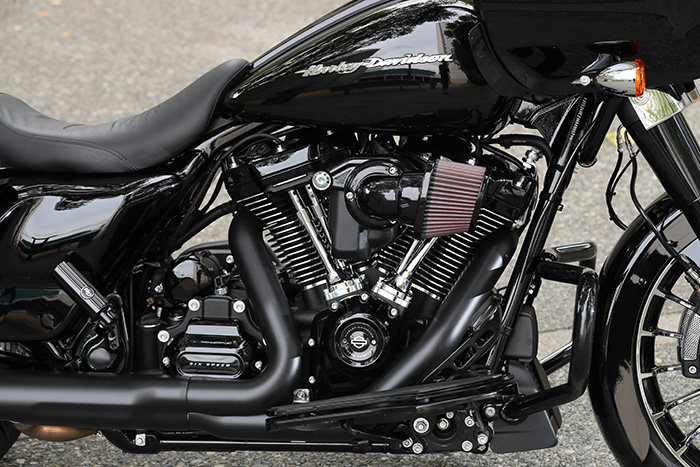
They had cut open engines where you could follow the path of the water and the oil and since water has a much higher thermal conductivity than oil, the cooling passageways around the exhaust valves needed to be designed differently for the oil-cooled models versus the Twin-Cooled ones. One of the hottest places in the head is the bridge between the two exhaust valves. Since water is so much more efficient at drawing away heat, a heart-shaped core only needs to get close to the bridge to effectively reduce the heat. On the oil-cooled engines, the cooling passages are actually drilled through the bridge, giving the oil access to the hottest point on the head so that the oil can carry the heat away.
To vibrate or not to vibrate: Harley’s design engineers focussed a lot of time and effort on finding the right amount of vibration to appeal to both the hard-core, traditionalist rider and the rider who looks at the engine jumping around in the frame at idle and thinks it can’t be comfortable or smooth at speed. When test engines were made with more complete vibration damping, the core Harley riders were unhappy while the potential H-D customers were satisfied. Since the core couldn’t be alienated in search of new Harley owners, a happy medium was eventually found in which vibration was reduced by 75%, providing a compromise where both factions felt the vibration was appropriate. 75% is a huge number and is more apparent when you go the other way around and go and ride an old engined bike.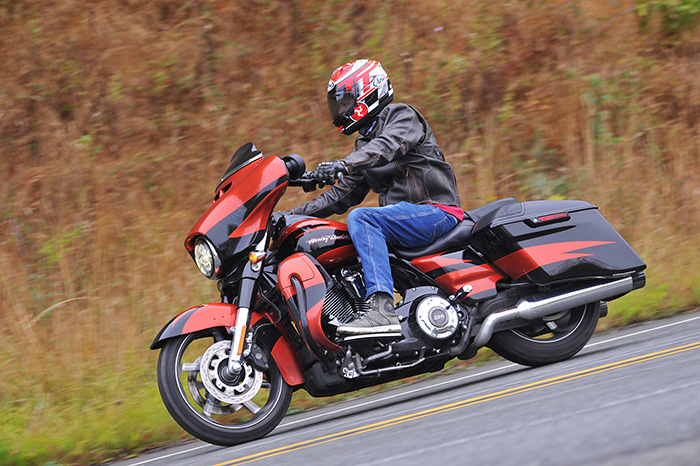
The charging system also received an upgrade. With the idle rpm dropped from 1,050rpm to 850rpm as part of the heat-reduction program, the previous system couldn’t put out enough amperage to maintain a positive charge, so it was doubled in size. Now, at 1,000rpm, it puts out 34 amps instead of 17 amps.
The clutch was upgraded to a torque-assist unit which requires 7% less effort at the lever thanks to the lighter springs used.
All in all, the engine has made huge strides forward, but as they are being put into the normal touring line-up of bikes, the suspensions also needed an upgrade.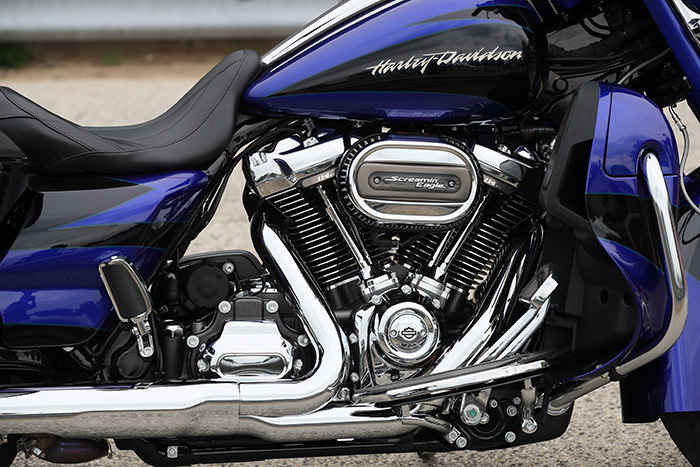
New Touring Suspension for 2017 models
Here Harley also used test groups of customers to find out what they wanted.
1. I want ride comfort and control for different loadings and roads.
2. I want to fine tune my suspension and it must have ease of use.
3. It must be reliable and not leak air, which the new system does not have.
All-new front and rear Showa suspension components enhance the comfort, control and performance of all 2017 Harley-Davidson Touring model motorcycles. New emulsion-technology rear shock absorbers offer 15 to 30 percent more pre-load adjustment than previous standard touring shocks, with a single knob to hydraulically adjust pre-load. ‘Pre-load can now be adjusted to match the load of rider, passenger and gear without tools or an air pump, said Paul James, Harley-Davidson Director of Motorcycle Product Planning. ‘Once set, the pre-load will not leak down or require further adjustment.’ The front suspension features new Showa SDBV suspension technology that delivers the damping performance of a racing-style cartridge fork with linear damping characteristics and reduced weight.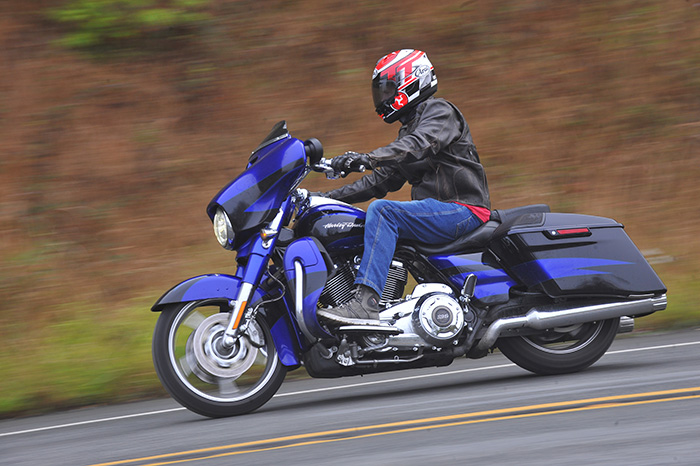
So after all this technical information on the bikes, what do the new 2017 Touring Harleys ride like? Luckily for me we were flown to Seattle in Washington to test ride for about 600km over two days going through their county and the Olympic National Park. Harley-Davidson had the whole fleet of bikes to test ride and at every stop we were encouraged to swap with another rider so that we could try most of the fleet. My first reaction as I said earlier was that it was too smooth but technology waits for no man and now that I’ve spent a few days with the bikes, this is ultimately the way to tour and do mileage and the engines have a lot to do with minimising rider fatigue. The off-beat patter is still there, the bikes pull from idle and the 10% gain in power can be felt and as we were at sea level the bikes felt strong. We were also in the USA and once when we reached 80mph we were immediately pulled over and warned. Although the engine was all the talk, to me the biggest difference I actually felt was in the suspension. It’s not firm and it’s not sporty, but it is dynamic and the amount of control I had over the last model was vastly improved. The roads we rode varied from highways to open sweeps to downright bumpy downhill tight corners and with all of them the new suspension just kind of shrugged it off. To all current Harley riders, the difference is huge.
Love them or hate them, one thing you cannot deny is that collectively they have presence and, once in the touring mood, few bikes can compare to mile eating American horses.
http://www.harley-davidson.com/