


 Words by Clinton Pienaar
Although this is a brand new bike, Ducati goes back to the roots of what made the Monster special in the first place and stayed close to the essence of the original bike.
The naked bike world is a fiercely competitive one, think of what’s available out there now and you’ll be surprised how many potential offerings are available. The engine line-up is also vast and ranges from V-twins and V4s, to Triples and even inline fours. Ducati launched the 1200 Monster only three years ago and I found it quite strange that they launched a new model so soon afterwards, but once you see the new bike for the first time it all makes sense. What made the original Monster appeal to such a wide audience (yes, the world was a different place back then) was that the bike sported small dimensions, was minimalist and had an aggressive street fighter appearance. The new bike is exactly that, but it’s packed with all the latest safety features. Looking back three short years ago, I remember the journalists’ comments directly after riding the bike and those were that it was so big. It had grown and maybe it had grown too much. Bikes like this, in this segment, have to be small, sporty and nimble, and that is exactly what this new bike is.
One can argue that the original M900 started this whole naked sports bike craze, but that’s a bar argument for another day. But what is, or was, true about that original bike was that it was supposed to make Ducati bikes more accessible to the masses and was supposed to be a cheaper offering to the bikers out there. Looking at the new bike and the S model specifically, the minimalist look is still there and it’s a small bike now for a 1200. However, nothing looks cheap on the bike, from the Brembo brakes and the Öhlins suspension to the TFT dash, everything just oozes quality and the new liquid concrete grey paint colour makes all these special components just stand out better. You do still get a red option but this grey is really nice.
So what about the changes on this bike compared to the bike it is replacing? There will, again, be two bikes on offer from the outset, those being the base model and the S. We only had S models on this test but what is good is that the engine offering is exactly the same on both models and the engine has been tweaked as well. It’s now 15hp more than the outgoing base model and 5hp more than the outgoing S model. Ducati achieved this by oval throttle bodies that are larger, running a ‘round equivalent’ area of 56mm (vs. the previous 1200’s
53mm ones) and an increased compression ratio of 13.0:1 (up from 12.5:1). The Monster 1200, which now meets Euro 4 emissions standards, produces a claimed 150hp at 9,250rpm and 126Nm of torque at 7,750rpm. Finally, the 2017 Monster 1200 has received more and improved gadgetry, with a full-colour TFT display and IMU that feeds the new cornering ABS and Ducati Wheelie Control (DWC) systems. The 1200 S comes with Ducati Quick Shift standard (clutchless up and down), but it’s an available option (price yet to be confirmed by Ducati) on the standard 1200.
Sitting on the bike, the fuel tank has been re-shaped and looks much smaller, although it only loses 1 litre in capacity, reducing it to 16.5 litres. What was nice to see is the return of the old ski boot tank clip which comes straight from the old original. The seat height can also be adjusted easily from 795mm to 820mm by a very clever, simple design feature under the seat. The TFT dash looks striking and features three different configurations known as Core, Full, and Track. Of course the data changes for each configuration, but what’s different is the gear indicator and fuel gauge, something that wasn’t available prior to this new model. What is the same as before, but worth a mention again, is that in all the different modes, while stationary, you can decide between wheelie modes (there are 9 to choose from), traction control levels (there are 8) and engine output modes which you can set in the memory. So then, when riding along, you can switch to Sport and in Sport you could have switched off Wheelie control, Traction control and ABS, then just by selecting Sport, you can have the bike just as you want it, and it will stay that way when you switch it on again. This is a very likeable feature on a modern bike where everybody is swearing green peace and hugging bunnies all the time.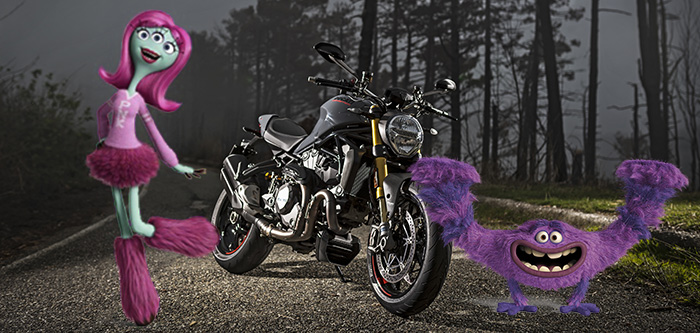
Then looking at the rear, it’s shorter and “r” shaped and because of this it makes the whole appearance look a little more buff. Even the headlight has been changed for a more traditional round shaped one but on the S it has futuristic daytime running lights.
The wheels between the two models are also different. The base model Monster 1200 comes equipped with 10-spoke alloy wheels, while the 1200 S makes use of Y shaped 3-spoke wheels with ‘S’ graphics. Another difference, and this is the biggest, is the suspension. On the base 1200 you get 43mm Kayaba forks vs. the 1200 S’ 48mm Öhlins forks, and the base model utilises a Sachs monoshock vs. the Öhlins monoshock. The S’ Öhlins just look so much cooler, find the money, you’ll be happy.
Chassis-wise it’s also been revised and it’s now 26mm shorter, mainly thanks to a new revised single sided swing-arm. The rake is 1 degree steeper and the tyres, which are solely supplied by Pirelli, have now been upgraded to the newer Pirelli Diablo Rosso 111s. In theory this should bring about a quicker handling bike. The bike has a wet weight of 200.5kg.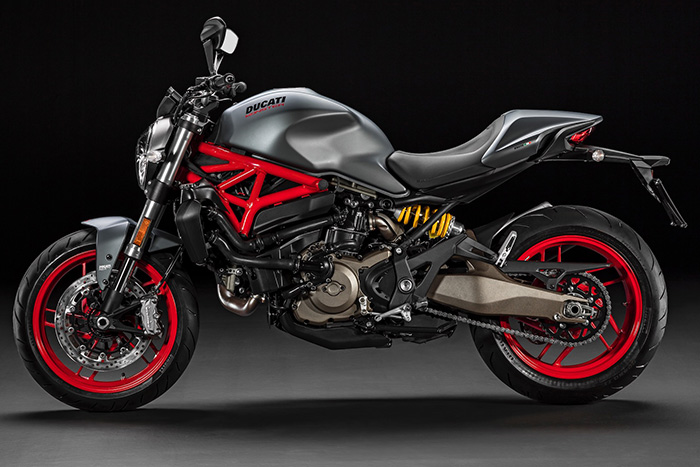
The Monster also comes standard with the Ducati Safety Pack which includes the Bosch Cornering ABS and, although it’s nice to know it’s there, I don’t think anybody is going to test it to the full until something really big and hard jumps out in front of you.
So what’s it like to ride you ask? Ducati set the scene by flying us to Monaco to test ride the bike in the streets of Monte Carlo and then into the mountains of the French Riviera next to the Mediterranean Sea which is, in essence, the most perfect place to ride a bike like this. We set off early after our press brief and what was immediately apparent to me was the low down torque of the engine. Obviously the engineers, knowing that this would be a town carving machine, have designed the engine’s pick-up like this. It’s faultless from just over tick-over and builds nicely with 70% of the torque available under 5,000rpm. Even the exhaust note is throaty and I’m surprised that Ducati got this right because of the very stringent European laws. I’m sure the guy testing Ducatis is a petrol head himself. Monaco itself is a puzzle all on its own. Never mind the fact that we were on the wrong side of the road but it’s a tangled ribbon of roads that lead you into tunnel after tunnel which takes you into the mountain and then pops you out higher and higher every time. The views are spectacular and the changing of the season brings with it the most awesome colours and scents. My only criticism came from the amount of hairpins but, as the terrain is so steep, this was the road builders’ only option. What it did do was give me the opportunity to test the Ducati DQS thoroughly. Up and down, riding slowly, I still preferred my up-shifts with the clutch slightly engaged but I felt I could do it smoother manually. At high speed during hard acceleration, the quick shifter is sublime. On the down-shifts, and on the road, this is something to wrap your head around; the DQS automatically and instantly increases the engine revs to meet the wheel speed of the gearbox in the lower gear as you push it down, it’s not so much a blip (which I would have preferred) but it’s a seamless process. My only criticism here is that it feels like you are pushing harder on the gear lever than you would have to if you engaged the clutch. Again, you don’t have to use the extra feature but it’s there if you want it. It’s very non-intrusive and I actually started enjoying the simplicity of it as I used it more and more. On paper the bike does not sound much smaller and I know it’s a perception thing here, but the narrower tank and shorter tail made the bike feel a lot smaller. I kept on telling myself to be objective but one’s feelings do not lie, the bike feels small and nimble, and, at high revs, the engine still pulls like a steam train, easily lifting the front wheel in third at sea level with wheelie control switched off.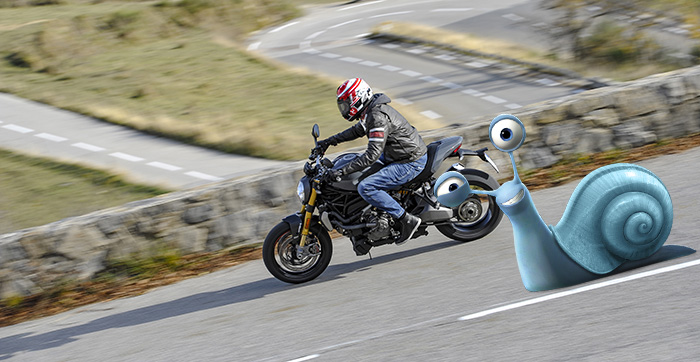
The roads in the mountains are not as smooth as one would think they could be but with the 48mm Öhlins up front and Öhlins at the back, as well as the straight up riding position, these road undulations were handled nicely. I did wish that there were some high speed corners because, by all accounts, you just know this bike will excel at those. I played around between Sport mode and Touring mode and, maybe it’s an age thing, but the throttle response and power delivery in Touring mode tickled my fancy. There is an Urban mode as well but I’m sure that’s just for when it snows because I can’t understand why you would take so much power away. The stopping power of the Monster is huge and here there is a difference between the two models. The standard Monster 1200 uses dual 320mm semi-floating rotors with Brembo M4 callipers up front, and a single 245mm rotor out back with a single calliper. As for the 1200 S, it features 330mm semi-floating discs with Brembo M50 callipers lifted straight off the Panigale. In either case, you’ll get an impressive amount of braking power, the S model I rode was phenomenal.
So in conclusion, has the Bologna factory got it right? Well I’d say that’s a resounding yes! For exclusivity, status, sex appeal and fun, all put together in a very classy package, you’d have to go a long way before you beat the Italians at creating a Monster with so much panache. Pricing will be around the R200k mark at this stage and that’s our SuperBike estimate and for that, you are getting a lot of bang for your buck.
Too see the full range of 2017 models logon to: www.ducati.co.za/

