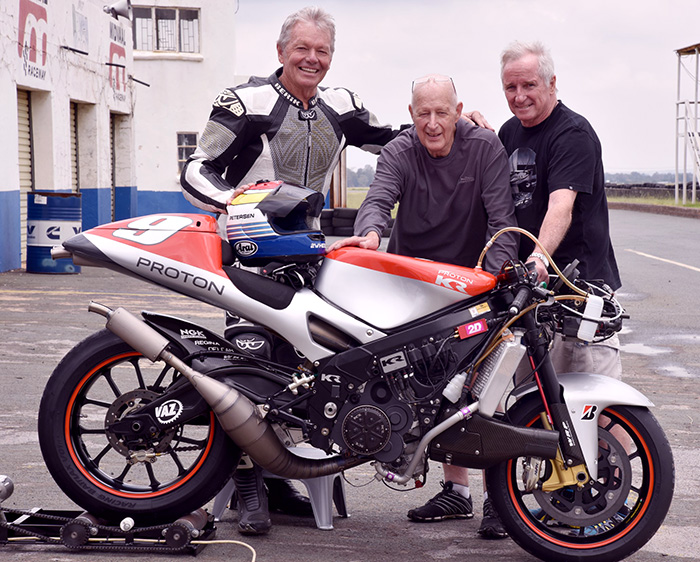
It all began with an early telephone call from good friend and competitor Rory Nesbitt. He was enquiring whether Kenny Roberts would be prepared to sell one of his Proton KR3 500cc Grand Prix bikes.
Rory had been trying to obtain a factory spec Grand Prix bike from the golden era of GP racing. Some might say that we are ‘now’ immersed in the golden era with the immense rivalry we are witnessing between Rossi, Marquez and Vinales et al.
Older MotoGP enthusiasts dispute this vehemently. They’re of the opinion that the era of the factory 500cc two-stroke bikes provided the best racing moments in history. The smell of scorched Castrol 747 oil combined with real racing fuel and the high-pitched whine of highly tuned two-smokers was an experience that new fans can’t comprehend.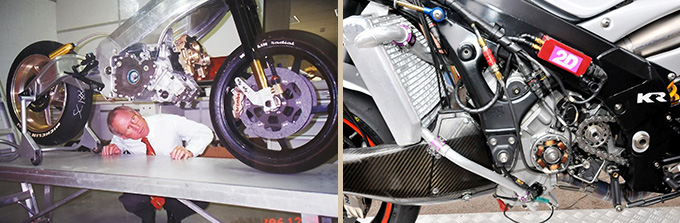
The problem with that era of racing was the stagnation of technological development. All the competing factories had settled on a proven formula of V-Four motors fed by carburetors and reed valves directly into the crankcase. These engines produced close to 200 ponies, more than sufficient to test the best Michelin and Bridgestone tyres to the limit.
Three times 500cc world champion Kenny Roberts had previously secured Marlboro cigarette money for a number of years. This enabled him to manage and own the official Yamaha race team. His riders were highly paid and well looked after. They were winning races and all seemed well in their isolated world of Grand Prix racing.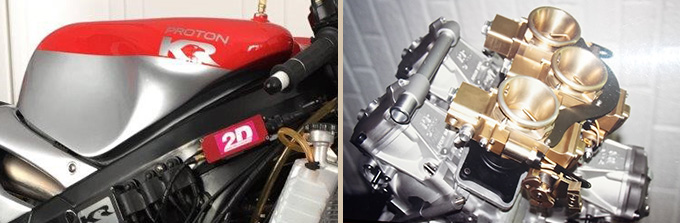
Kenny Roberts, by nature, was always looking to move ahead of the opposition. He’d been instrumental in obtaining better conditions for Grand Prix competitors and saw a much larger landscape for his beloved sport. The technical stagnation was of concern to him.
His team of technicians was known as the ‘Brain’s trust’ in the paddock. Antipodeans Mike Sinclair and Warren Willing constantly urged Kenny to try and sway the Yamaha factory away from their existing technology. The other conundrum facing Kenny was that as long as his star rider, Wayne Rainey, continued winning races on the YZR500 the Yamaha factory would not invest any more cash in development.
Wayne was riding the Marlboro Yamaha well beyond the limit and it was only a matter of time before it all ended in tears. Wayne’s career ending accident at Misano in Italy was a tipping point for Kenny. Yamaha had finally pushed him over the edge and the embryo of plans he had to build his own machine was fertilized and ready for harvest.
Kenny and the ‘Brain’s trust’ began making enquiries within the Formula One world about engine and chassis manufacture. His team had the nickname of “The Evil Empire” and when he announced to the world that he was going to build his own machine there were many in the paddock that looked forward to the demise of the “Evil Empire.”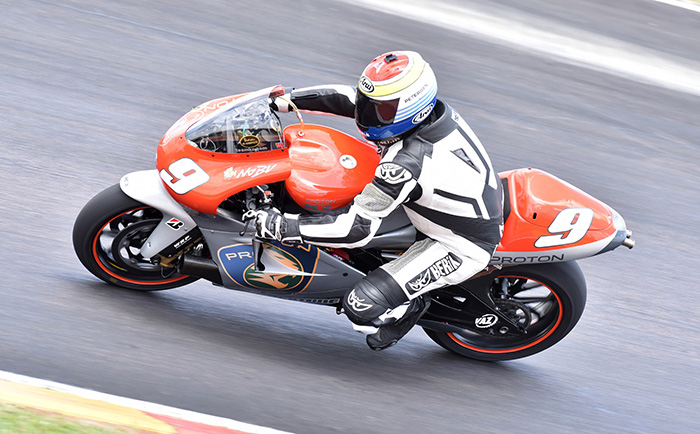
Nobody believed that a ‘homemade’ bike could take on the might of the land of the Rising Sun. But when Kenny announced that the engine would be a THREE-cylinder unit they thought he had lost his marbles.
The reasoning was that a V-Three would produce equivalent power to the V-Four’s. Grand Prix regulations also allowed for less mass on two and three cylinder bikes. So, Team Roberts set about building a 500cc machine with similar dimensions and weight to a 250cc machine. The first-generation Modenas KR3 was built with the aid of Tom Walkinshaw Racing based in England and weighed in at 120 Kg and power output was around 180hp.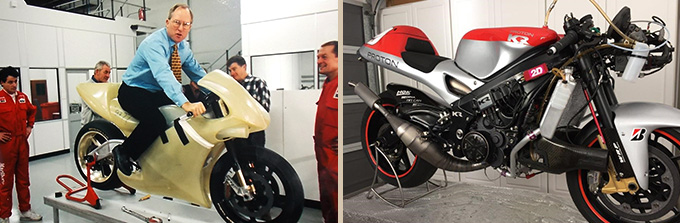
The bike was reasonably fast, but the main problem was engine vibration and after a lack luster season with French rider Jean Michel Bayle accompanied by Brit Jamie Witham, the ‘Brain’s trust’ decided to re-design the engine layout utilizing two upper cylinders and one lower in the vee configuration.
The new model was much smoother to ride and the team was the first to experiment with electronic rider aids as well as D2 telemetry. The name was then changed to Proton, courtesy of the Malaysian manufacturer.
The Proton KR3 came of age in the year 2000 but rule changes allowed 990cc four stroke prototypes to compete alongside the 500cc two strokes. The writing was on the wall for Kenny and it wouldn’t be long before his team had to follow suit with a four-stroke bike.
One could say that the KR3 simply missed the boat and was a year or two too late in development. Also, Kenny could not entice any of the leading riders to ride his machine, hence the lack of results. The highlight for the Proton KR3 would have to be Jeremy McWilliams’ pole position at Phillip Island against the four-stroke opposition.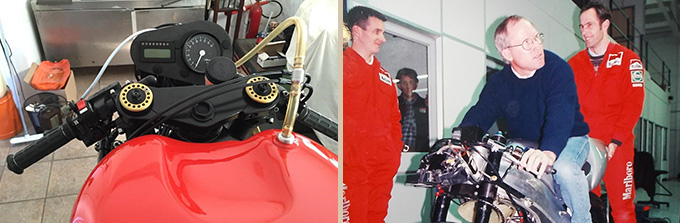
Back to the future and Rory’s enquiries via Robbie Petersen saw the purchase of not one but three KRs! They now reside in Durban and Rory has painstakingly rebuilt the machine that Nobby Aoki raced in the Grand Prix.
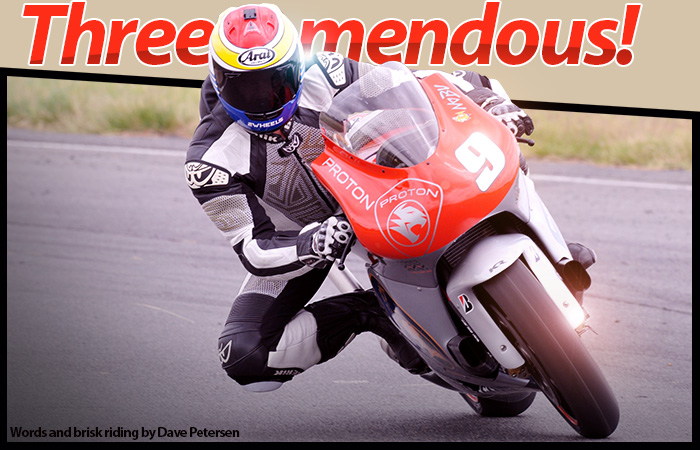
Now it’s 2017. I was nominated as the test rider and I was a bit nervous in throwing my leg over the saddle of this diminutive machine, wouldn’t you be? When a bike hasn’t run for fifteen years you do tend to take it very easy in those first exploratory laps, especially with something that’s basically priceless!
Unfortunately, we did not have the correct connection for the engine management program. We simply had to go with the settings as per the bike’s last race at Brno in Czechoslovakia. As it turned out, the settings were perfect.
The KR3 was displayed at the recent Day of Champions event held at the Zwartkops Raceway near Pretoria. As I clambered aboard for a few laps around the tight and twisty circuit bystanders were simply enthralled with this unbelievably rare machine.
The exhaust note is surprisingly and disappointingly flat to say the least. It almost sounds like a Vespa scooter. This is due to the ‘big-bang’ firing order of the three-cylinder power unit. Do not be fooled by the noise. Beneath those gorgeous carbon fiber body parts lies an angry engine that produces almost 190hp at 12 thousand RPM! Combine this with an all up weight of only 120Kg (around the same as a cheap 125cc commuter bike), and it equates to a rocket ship of a bike.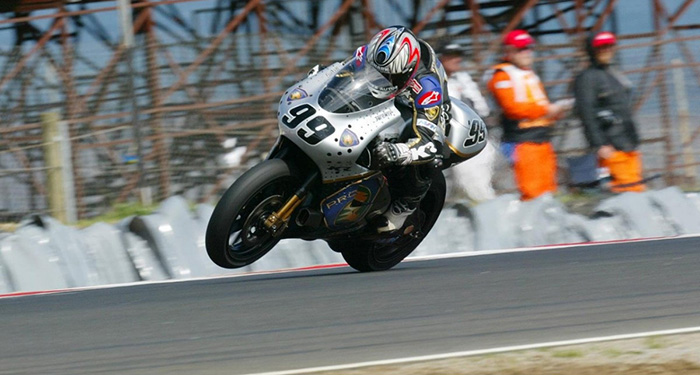
I honestly believe a current national rider would dip well under the lap record at Zwartkops on the KR3. If he could come to terms with the immensely powerful carbon disc brakes and the very different, and sometimes violent, two-stroke power delivery.
I did ask Rory what it’s like to work on and he exclaimed that it’s a jewel, almost like a Swiss watch. Every single component is manufactured with one thing in mind and that is to go around a racetrack as fast as possible. Team Roberts were extremely mindful of simple maintenance to the point that no hand tools are required to remove the bodywork, radiator or fuel tank, very clever.
The internal gearbox ratios can be removed and altered in a matter of minutes. The suspension is limitless in adjustment as is the steering rake and trail. It’s simply a gorgeous motorcycle on all counts.
I had to share the track with the Historic Motorcycle Group and a big thank you goes out to them. I hope I didn’t interfere with any of their personal on track battles. But heating the fabulous Bridgestone slicks, as well as the carbon brake discs, does require some aggressive riding. The KR easily lofts the front wheel in third gear at close to 190kmh! What a thrill to do so. Hell, I even felt like my hero Kenny Roberts for a few moments out there.
This is by far the best motorcycle I’ve ever ridden and what an honor bestowed on me by owner Rory Nesbitt, a truly remarkable experience that I’ll never forget. It also makes me a little sad that two-stroke GP bikes, like this, are now only destined for demonstration activities, but at least fans can still get to see them in action – Three-mendous!