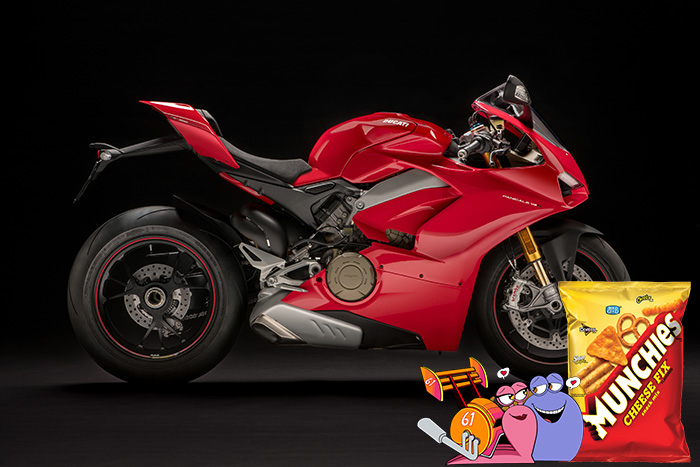
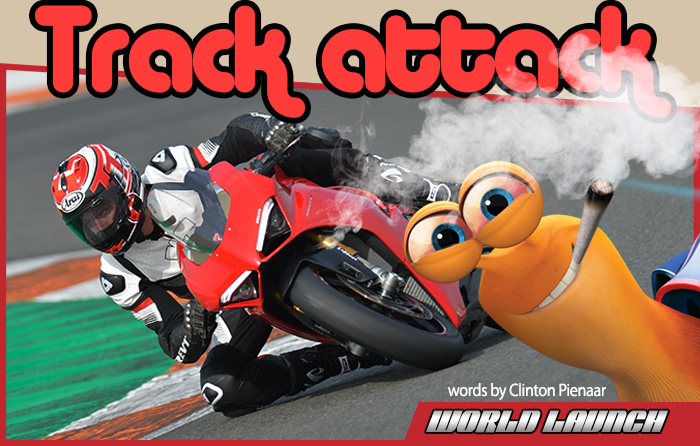
 The Panigale V4 is the new bench mark in the superbike class and replaces the iconic 1299 at the top of the Ducati supersport range. For Ducati to move away from its traditional V-twin layout to a V4 is monumental, but I'm pleased to announce the Italian firm has hit the nail on the head!
The line between reality and fiction is becoming a little blurred at the moment. As the world advances, we become a little cleverer each year and push the envelope a little further. You'd think that we'd get to a point where said envelope can only be pushed a smidgen further, if any, as we’ve already pushed it a hundred times before. Think of the Olympic records; no one smashes them out of the ball park, ever! It's always just a little creep forward and even then you need to check that the athlete’s blood is not DayGlo green.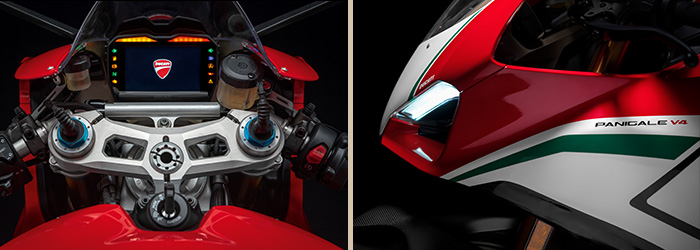 But in the biking world, with electronics being the new buzz word, the advancements are enormous. Yes, power is also very important and Ducati are bringing a cannon to a gun fight with their 1100cc V4 competing against the 1000s, so already the other manufacturers are at a 10% disadvantage before they even start. And the V4 is derived straight from their Ducati MotoGP bike (arguably the fastest of them all) which Dovi and Lorenzo ride. But the line gets blurred in the way it makes the rider wonder if it is him or the bike.
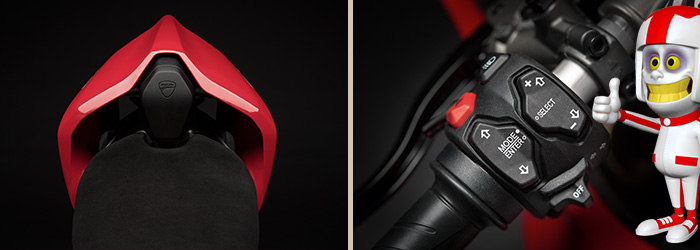 Let me explain further; this launch took place at the Valencia Circuit and, in the riders’ briefing, the Ducati test rider (Alessandro Valia) told us that while we were in 4th gear, going over a blind rise left hand corner, we should just roll on the gas to full stop and let the bike take care of the rest. There is a hundred metre short straight as you exit that corner and then you need to brake really hard for the tight, 2nd gear corner onto the straight. Even there, while braking and leaning in, he encouraged us to take full advantage of the 6 axis cornering ABS that will not make the back wheel lift or cause us to lose the front. Right, easy then and do what he says obviously... NOT! So as I got on the bike for the first few orientation laps, my immediate impression was lightness but I also experienced the sensation of over-riding which, upon further pondering, I felt was caused by the lack of V-twin throbbing. This bike's engine is smooth, it’s free revving like a tuned 600 with a very light throttle feel (read fly-by-wire).
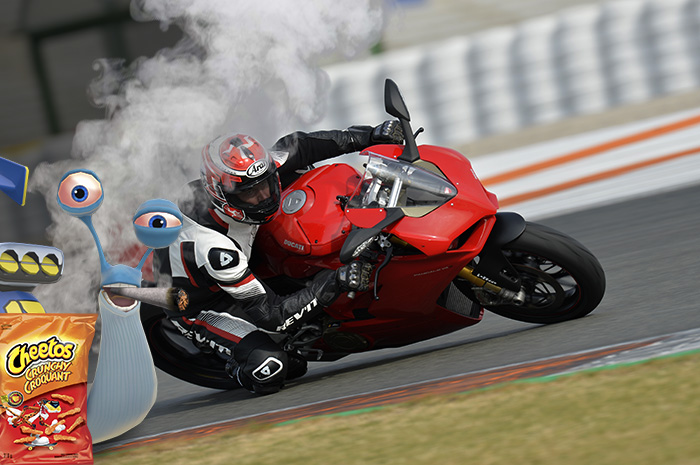 I started lapping and getting to know the circuit, obviously giving it the berries on the straight. Blimey, the pull of this motor is strong and smooth but then it gets into a rush from just over 8,000rpm that is quite phenomenal. It's a short straight and I got to 280km/h quite consistently. The bike even went a little faster than that but, by then, I was honing in on the corner that Marquez almost lost it at in the last MotoGP race of last year. What a rewarding and awesome corner once you get it right, but I digress. After a few sessions I was in tune with the V4 weapon of a bike and I loved the way in which its neutral nature was making me ride. I could just lean further and further and gas it on earlier and earlier. Every lap, as I approached that 4th gear, blind rise, left hand corner, I remembered Allesandro's words; ‘Just gas it you'll be ok.’ But I couldn’t possibly trust the electronics that much, could I? Let me also add in here that this bike, with all the electronics removed and in its hardware form, is so much better than last year’s Panigale, never mind the 1198R from even further back or even the earlier 1098S which I raced. Just in chassis, brakes and dynamic grip from the longer swing arm and better tyres and suspension, the Gs experienced during cornering and the grip generated from the advanced chassis is quite surreal.
 Now add to this experience, I was already going faster than I would have ever gone on any other bike, but I was pushing harder and harder, knowing I had a parachute on my back that would catch me should I push too hard (read advanced 6 axis TC). There was no time to look down to see if the TC light was flashing, but what was happening was that as I started to lift the bike up, whilst keeping myself hanging off, the tyre was obviously finding more traction and the management system was releasing more horsepower, but in a very controlled, forceful, smooth push from behind. I was not opening the throttle more, I didn’t have it at full stop open but I was close. The forward force is immense and you need to hang on properly and be fit. The little 100m straight started feeling shorter and shorter and the braking..... let me get there just now.

So as I started to put my trust into the TC and push harder and harder I realised that it was the bike and not me. I started moving my weight around to get the squirt out of the corner more and I was beginning to realise that this modern way of riding superbikes fast is actually taking away the essence of what makes a super fast rider a super fast rider. Don't get me wrong, this is the way forward, but it just gives me more respect for Schwantz. To go super-fast on one of these advanced projectiles, you'd first have to be a fast rider, then trust the electronics fully (this is easier with less age on the dial) and then you, together with your race engineer, will find a setting. From there you'll have to ride the wave that is your electronics and moving your weight around to be able to get more grip to release more power. Make no mistake; this is by far the fastest way out of a corner, even if you are racing Schwantz.
Now on to the braking and especially into the tight, 2nd gear, left hander; the Ohlins (like on the Honda Fireblade) has three aspects of setting the suspension up. The first one is braking into the corner, then mid-corner and then the exit. Quite clever really as you always have to compromise with regards to your settings if you are on a ‘normal’ bike. Here you basically have three bikes; the first one which is set up for braking into the corner, the second which is for as much stability as you like when braking hard, and the third for mid-corner to hold the line, not drift wide and to exit the bike. Here you can select the way you want it to feel and it will automatically do just that at every exit. The multitude of adjustments is almost unending but the good news is that, in its standard set up, the bike is amazing. I fiddled a little but we only had five sessions on circuit and we shared a bike, so time was limited.
Let me take you through the highlights of this technological masterpiece.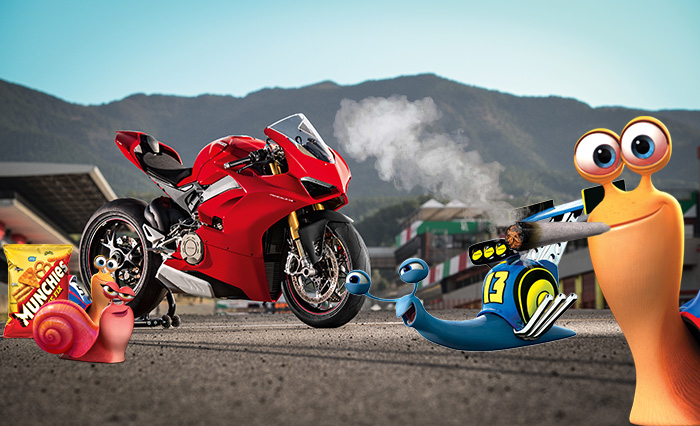 ENGINE
As the engine is major news, let's start here. It's called the Desmosedici Stradale and it's a 1103cc, 90 degree V4, desmo operated 16 valve mill. It has the same bore of 81mm as the MotoGP bike but it has a longer stroke to help get the extra capacity. It's got a claimed 214hp at 13,000rpm and a torque figure of 124Nm at 10,000rpm. Although these figures seem high in the rev range, it’s incredibly usable from low rpm. Where the 1299 V-twin would shudder, this bike just spins up. The (DQS) quick shifter is also standard up and down and now I'd find it hard to go back to a clutch operated shift pattern. The slipper clutch is used for pull away and stopping only, that's it. Ducati’s Twin-Pulse ignition system, which fires the two left hand-cylinders in quick succession, followed by the two right-hand cylinders, gives the V4 engine a V-twin sound and characteristic at low revs, but it quickly morphs into its V4 form as the revs race toward the 14,500rpm redline. 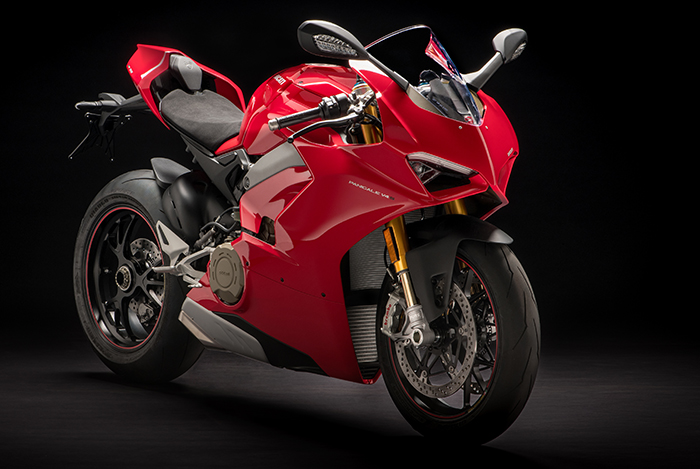 CHASSIS
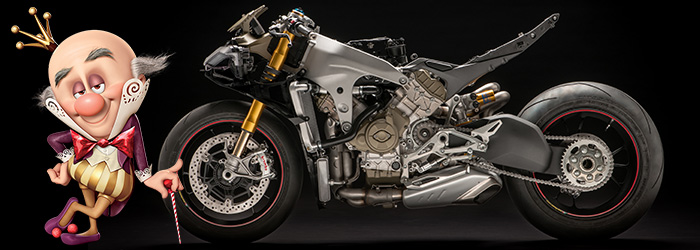
Aluminium alloy front bolted onto the engine which makes it a structural part. The ‘Front Frame’ features a compact frontal structure weighing only 4kg, secured directly to the upper semi-casing of the front bank and to the cylinder head of the V4's rear bank, the engine block also serving as a connection point for the rear suspension and pivot point for the single swinging arm. The most important advantage of the ‘Front Frame’ is the use of the Desmosedici Stradale engine to achieve the desired rigidity, making it possible to significantly reduce the extension of the main frame - and therefore its weight - achieving a superior rigidity/weight ratio.
SUSPENSION
The new Panigale V4 is equipped with a 43mm diameter Showa Big Piston Fork (BPF) that is fully adjustable in the compression and extension of the hydraulic brake and in the spring preload. The fork sleeve seats chromed legs to which Brembo radial brake callipers are attached. The front package is completed by the Sachs steering damper. On the back there is a fully adjustable Sachs shock absorber that on one side is attached to the Desmosedici Stradale with forged aluminium. The new Panigale V4 S and Panigale V4 Speciale are equipped with an Öhlins NIX-30 fork, Öhlins TTX36 rear shock absorber and Öhlins steering damper with event-based control system. On these versions, the suspension and the steering damper are controlled by the second-generation control system, Öhlins Smart EC 2.0, featuring, among other things, the new Objective Based Tuning Interface (OBTi).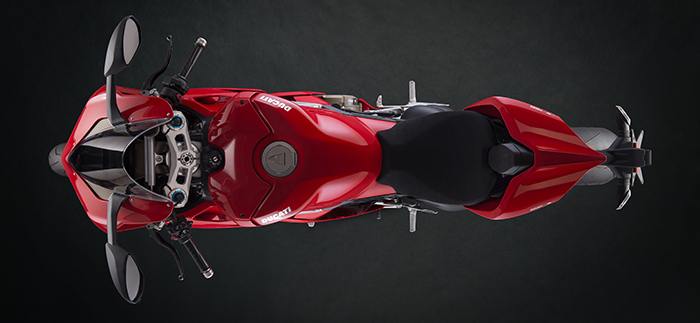
RIMS AND TYRES
While the new Panigale V4 mounts 3-spoke cast aluminium rims, the new Panigale V4 S and Panigale Speciale are equipped with 3-spoke aluminium alloy rims. Ducati and Pirelli worked closely together in the development of the new Panigale V4, the first motorcycle to use the new Pirelli Diablo Supercorsa SP as original equipment, 120/70 ZR17 on the front and the revolutionary 200/60 ZR 17 on the back. The latest version of the Diablo Supercorsa SP in the new 200/60 ZR 17 size, already widely used as slicks in the FIM Superbike World Championship.
BRAKING
The Panigale V4 range exclusively incorporates the brand new Brembo Stylema monobloc callipers that represent the evolution of the already high performance M50 callipers. The new Stylema callipers, machined from a single alloy block, have some lightened areas on the body and the fastening bushings that, compared to the M50, make them visibly more compact and allow a weight reduction of 70g per calliper without loss of rigidity. The braking system is supported by the ABS Cornering EVO system, which uses the lightweight 9.1MP Bosch control unit. The Bosch ABS system, equipped with ‘Cornering’ functionality that engages the ABS even when the bike is leaning into a curve, has evolved extensively with the introduction of new intervention logic and control types. Bosch EVO ABS Cornering can be set to three different levels to fully meet track and road driving needs, even in the most critical low-grip situations. While level 3 is indicated for the road or for low-grip conditions, thereby ensuring safer and more stable braking, levels 2 and 1, which give priority to braking power, are more appropriate for racing on high-grip surfaces and racetracks. Level 2 selection makes it possible to safely slide into curves for better performance in sports riding. Level 1 of the ABS, recommended for use on the track, engages ABS only on the front brake, but maintains the ‘Cornering’ feature that allows braking deep in the corners and to recover from any riding errors.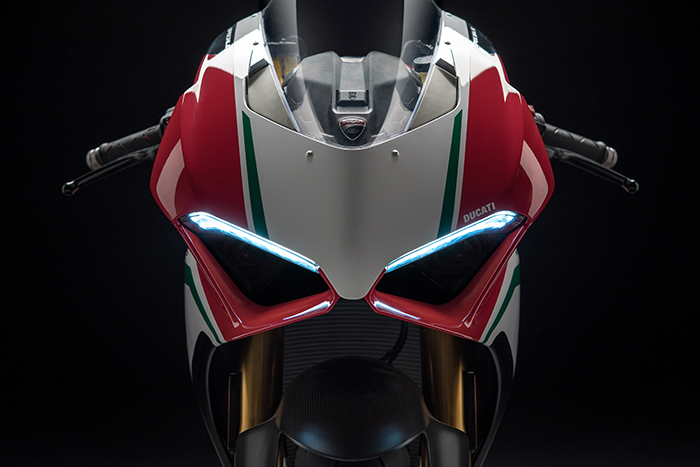 ELECTRONICS: DUCATI TRACTION CONTROL EVO DTC
The DTC EVO on the new Panigale V4 is based on an algorithm that makes its interventions more precise and quick. The DTC EVO interfaces with the Bosch Inertial Measurement Unit (IMU) by constantly measuring the bike's angle and using this information to better judge the actions necessary to ensure ideal slipping of the rear tyre (depending on the DTC EVO level set). Additionally, the DTC EVO provides for the intervention of throttle body valves as well as the management of advance firing and injection. In all situations where a rapid intervention of DTC EVO is not required, the use of throttle body valves makes it possible to maintain optimal combustion parameters, resulting in a more fluid intervention and response of the Desmosedici Stradale. With simple traction control, when slipping of the rear tyre is detected the system will intervene to control it. When the grip returns to optimal levels, the system reduces its engagement until the slipping occurs again. And the cycle repeats. This translates into a chart in which the intervention oscillates around a theoretical ‘line of ideal intervention’ that represents the traction limit. The DTC EVO reduces the magnitude of these oscillations by orienting the system to engage near the perfect line of intervention. This kind of behaviour is particularly advantageous as it interferes minimally with the dynamic balance of the motorcycle. Furthermore, the system is designed to be more robust and consistent, making it possible to maintain a constant and predictable behaviour even when the grip changes, as in the case of rear tyre wear. In addition to the greater precision of intervention, when set to level ‘1’ or ‘2’, the DTC EVO adds a new function called ‘spin on demand’ that allows the rider to control the bike at a level previously only achievable by expert or professional riders. Now, when the bike is cornering, the rider can use the throttle to request slippage that is greater than what is achieved with the normal level of intervention so that the motorcycle, pivoting on the front wheel, can over steer the curve. The DTC EVO makes this possible while keeping the safety parameters under control, making it possible to over steer with the rear wheel.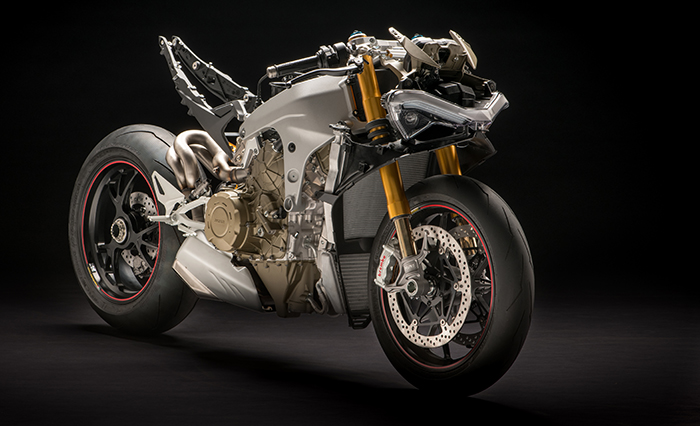 DUCATI SLIDE CONTROL DSC
The introduction of the 6D IMU has made it possible to add Ducati Slide Control (DSC) to Ducati Traction Control EVO (DTC EVO), developed in collaboration with Ducati Corse. This system supports the rider by controlling the torque delivered by the Desmosedici Stradale engine based on the slide angle. Its objective is to improve performance coming out of the corner by preventing slide angles that could otherwise be difficult to handle. The DSC works thanks to the 6D IMU that provides the vehicle dynamics control unit with information on the motorcycle's dynamics (such as lean angle, acceleration and much more). Thanks to these data and depending on the level selected by the user, DSC extends the use of the bike to all by providing improved assistance in extreme riding conditions.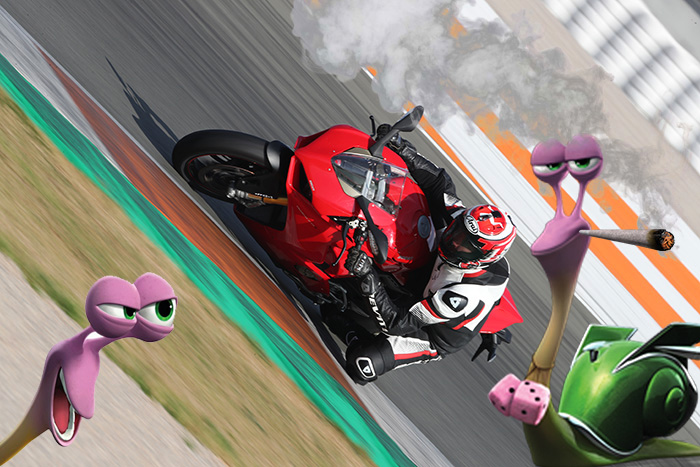
DUCATI QUICK SHIFT UP/DOWN DQS
The DQS EVO with up/down function, fine tuned for the Panigale V4, compared to the previous 1299 system Panigale uses the lean angle information to maximise the motorcycle's stability during shift changes in corners. Besides minimising shift times, the DQS EVO allows downshifts without using the clutch thereby ensuring even more effective braking into corners. The system consists of a bi-directional micro switch integrated into the lever linkage that, with every change of gear, sends a signal to the Desmosedici Stradale control unit. The system acts in a different way for up shifts and downshifts, supplementing the advance firing and injection action during up shifts with the controlled opening of the throttle for downshifts, thanks to the full Ride-by-Wire system. The magnitude and duration of the various actions are designed to ensure maximum fluidity in the engagement even during extreme racing conditions, during downshifts working together with the slipper clutch and Engine Brake Control (EBC).  The new V4, because of all these electronic interventions that happen without you knowing, actually make you ride a bike a lot better than you thought you could.
We all got a turn on the Speciale which is equipped with the 226hp motor with the lighter rims and WSBK slicks. Unfortunately my turn on the bike was in my first session on track as I drew that session so, all things equal, I could not really report accurately on this bike as my head was still spinning because of being let loose on Valencia for the first time. But, down the straight, at exactly the same place, when I looked down I was going 10km/h faster which means, even though I am blown away with the S version, in a race I'd prefer to be on the Speciale.
PANIGALE V4
PANIGALE V4S
PANIGALE V4 SPECIALE
4 more info: www.ducati.co.za/