It’s just after 8pm, I’ve just finished my dinner and the sun is still out. Where am I? Ever heard of a place called Ascari Race Resort? No? Well it is a privately owned circuit situated in the southern part of Spain, in a place called Ronda.

This is an extremely exclusive circuit only for the rich and famous. To give you an idea, and why I say only for the rich and famous, to become an exclusive member at this circuit will set you back around R2 million. To be honest, I think there could be worse ways to spend my days and I am one of the privileged few in this world because I was able to do a full day’s worth of riding at no cost to me except my time.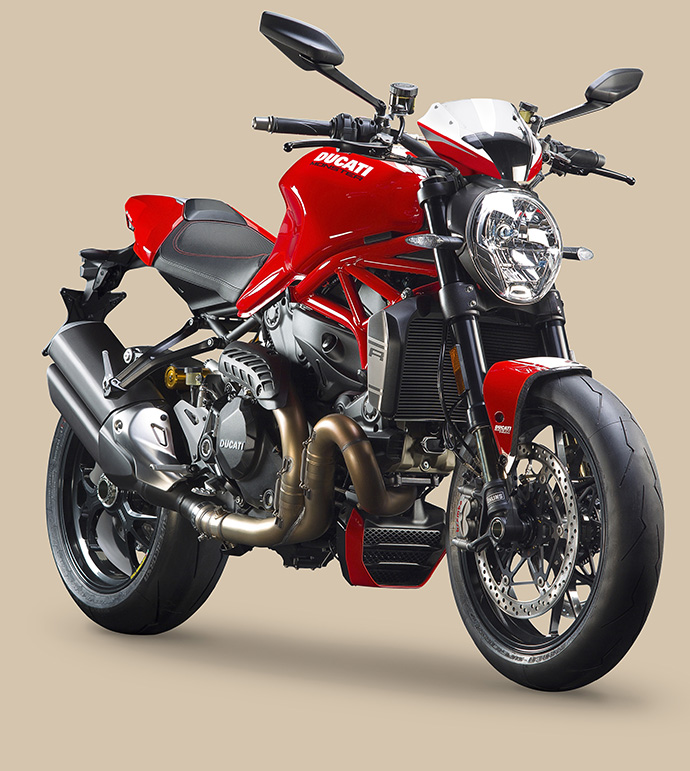
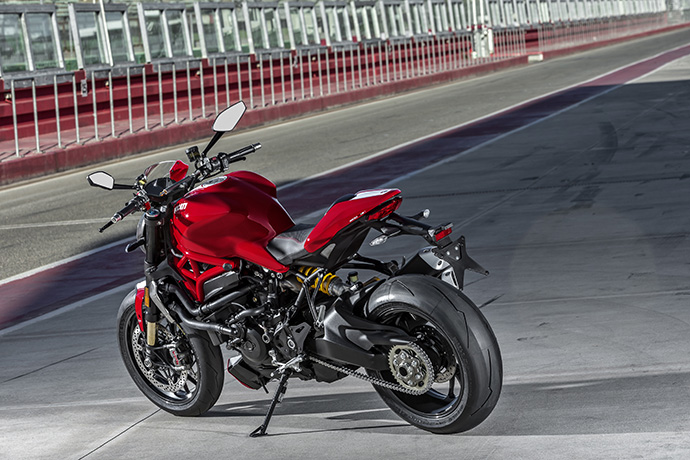
Ducati is the reason why I trekked all the way to Spain for a second time in the same month. They have added another letter to the end to their already successful Monster 1200 model line-up and the letter that stands at the end of this particular model is the letter ‘R’. A Ducati that has anything ending with an ‘R’ promises loads of performance and shiny trick bits fitted with logos that even your granny would recognise, and you just know that these bits will cost quite a few bucks to purchase separately. The Monster 1200 R has filled the space of Ducati’s most powerful naked bike ever made. Inspired by race track enthusiasts, the bike promises to not disappoint. 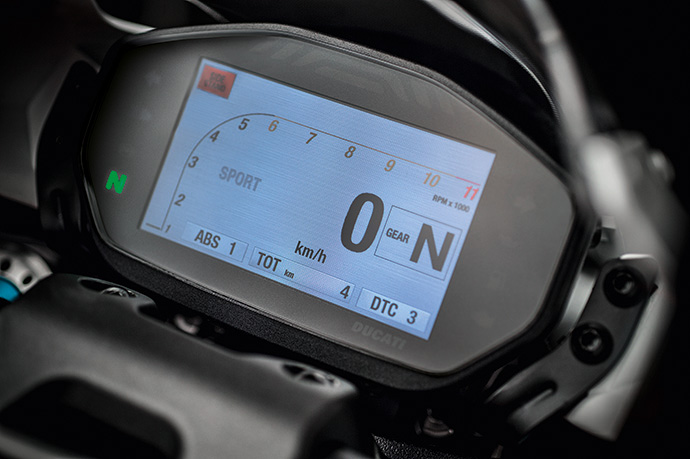
AT FIRST GLANCE
Playing the ‘guess what’s different game’ between the 1200 S and the 1200 R models with the journalists from around the world, the most noticeable difference was found at the rear of the bike. Naturally, I like a good looking rear, and the new, slimmer curves of the Monster 1200 R rear seat section suggest that the designer had the curves of a beautiful Italian lady in mind. This was a great guess as in the middle of the media briefing, this is exactly what the designer said had inspired him and I can’t blame the man! Overall the Monster 1200 R still holds its bull-like posture as does its siblings. Ducati have added a very neat flyscreen to, well, keep the backside of your clocks cleaner I’m guessing because it will do nothing for wind protection and underneath that sits the traditional Monster trademark LED headlight which most find ‘fugly’. The footrests are more race-like on this model and offer the rider’s foot plenty of grip on track. The exhausts have also changed shape and are slightly angled to improve clearance during extreme lean angles.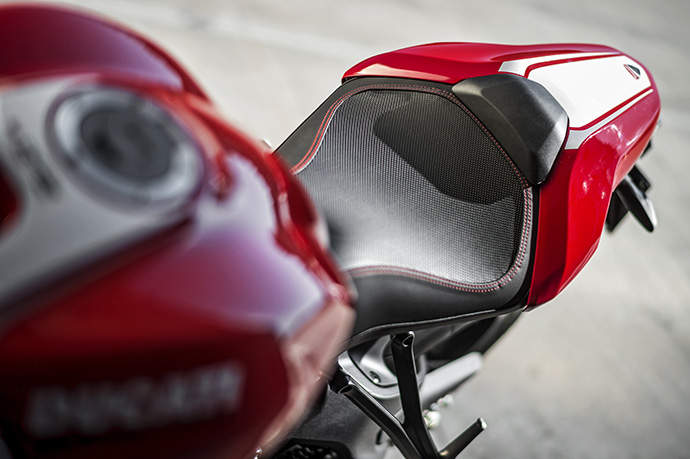
ENGINE
The 1200 R offers the rider a liquid-cooled, 1,198cc Testastretta 11 degree motor. Although the heart of this model is majority shared with the 1200 S, there are a few differences which make this bike deserve the ‘R’ stamp. Some of the differences include a larger set of elliptical throttle bodies that have increased to 56mm, the exhaust system which has been re-designed and the pipe diameter which has been increased to 58mm. The gasket thickness has also been reduced which has increased the compression ratio from 12.5:1 to 13.0:1. An increased compression ratio naturally improves the power and with a claimed 160hp at 7,250rpm and 131.4Nm of torque at 7,750rpm this suggests that this bike will tickle the proverbials of any horsepower junky. For such a high powered engine, would you believe that Ducati recommend a service at only every 15,000km? Nowadays Ducati really do make extremely reliable motors that have come a long way from the old days, so flush away those old tales of unreliable Ducatis and welcome the modern generation.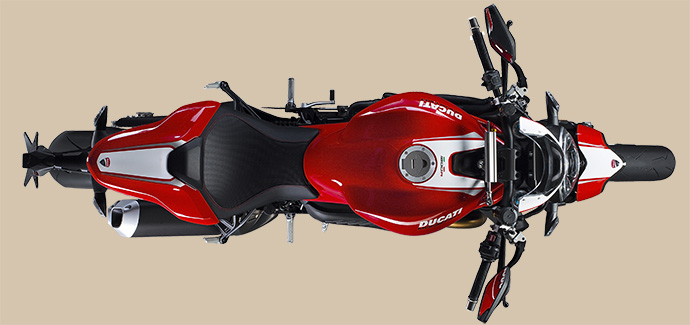
CHASSIS
Sticking to the Ducati tradition, the tubular steel trellis frame is mounted directly to the cylinder heads. For the first time in the Monster range, an Öhlins steering damper has been added as a back-up should the bike need to be kept in line. This Öhlins add-on is complemented by gorgeous Öhlins blacked-out front forks which were made especially for this model and an Öhlins rear shock. In life, most things are always best nude and, with trick porno bits like these, wouldn’t you too want to show your parts off? Having said this the Monster 1200 R is no exception. The Marchesini forged wheels have been taken from the Panigale Superbike and conveniently wears a 200-section rear tyre which comes in the form of the Pirelli Supercorsa SP, in traditionally ‘R-style’. The seat height is 830mm, which is 15mm higher than that of the ’S’ model and the reason for this is so that you are able to now crank the bike over to achieve an impressive 50 degrees of lean angle. What holds you 830mm above the ground is the completely revised seat and tail section. The sub-frame has been slimmed down to, again, match the curves of a sexy Italian female and is wrapped in a skin tight seat to show off the lines of the bike. The bike comes out with a rear seat cowl that can be easily removed if a pillion were to tag along. The rider and pillion pegs are re-designed into proper race-style pegs and the pillion pegs can be unbolted within a few minutes.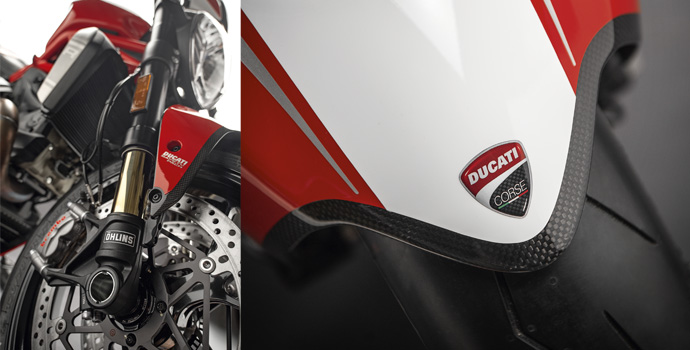
BRAKING
The brakes do not disappoint, in fact they were, for me, near on perfect and I’ll explain why later on. The front section includes radial mounted M50 Brembo monobloc callipers and a single piston calliper sits at the rear. Sintered pads controlled by a three-mode Bosch ABS system prove to be an incredible combination offering complete control to the rider. The Ducati Safety Pack (DSP) offers three riding modes and eight levels of Ducati Traction Control (DTC). Any of the riding modes (Urban, Touring or Sport) can be programmed to suit the conditions but the power is set to a controlled setting for each mode.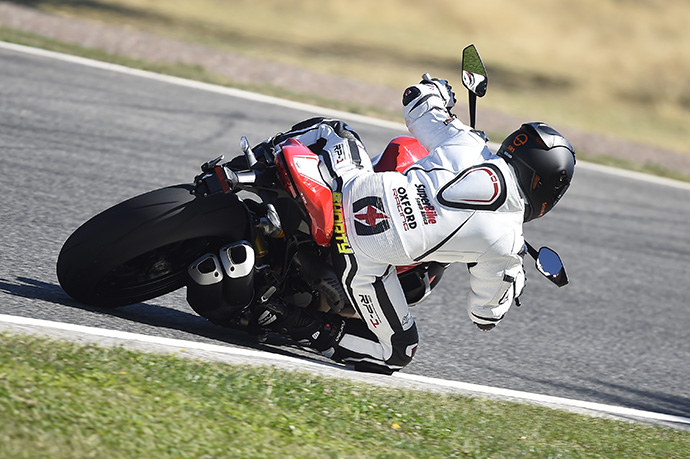
RIDING
I spoke a little earlier about the Ascari circuit in Spain so I hope you have done a little ‘Googling’ on the track by now. If not, Ascari is the longest track in Spain and one of the most spectacular in the world. The full circuit is 5,425m long, with a consistent track width of 12,2m. The track is also quite undulated and offers many banked corners which make every lap exciting. Very excited to not only ride the bike, but also this amazing circuit, I convinced myself that I would take it easy in the first session.
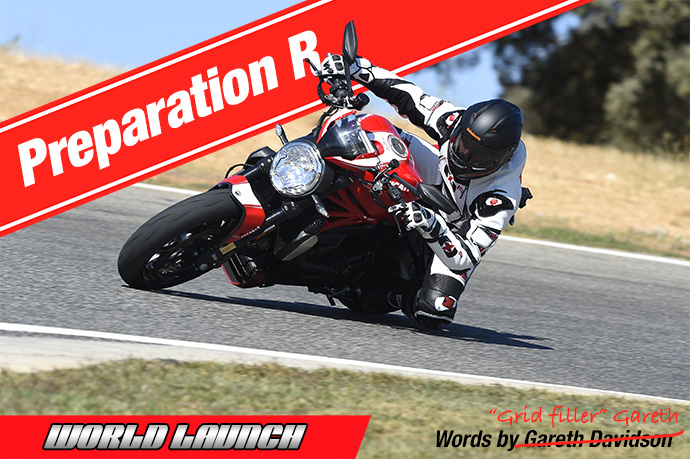
Unfortunately I ate my own words and, as I left pit exit, I christened the 1200 R with a little wheelie to turn two. Right, now that the ice had been broken, I was certainly on a mission to push hard in order to find the limits of the bike. Ducati asked us to spend the first session in Touring mode which offers less power and a lot more rules of restriction. So, in other words, the bike had a bucket-load of traction control and ABS for those less brave. Throttle response was really good, crisp and clean. The suspension sat plush and did everything asked of it. The brakes, as mentioned before, were most likely the best part of the bike for me and I’ll tell you why. On the opening lap of the first session, we set off at 10 second intervals. By the closing stage of the first lap I had managed to catch two riders in front of me, and immediately went into ‘beast’ mode. Not knowing which way the track went, and suffering from a short-term disease called rider fixation, the riders in front of me both sat up and threw anchors down. I very quickly saw why, and was greeted by a 110 degree hairpin coming from a 180km/h banked turn. I grabbed a handful of Brembos, the ABS system giving me a massive pulsating lecture through both hand and foot brake levers but, to my wide-eyed surprise, I managed to look pro and didn’t even run wide while overtaking both riders. Casually I lifted my hand to apologise and immediately dropped my head to break away from them in case they didn’t like my move.
By the fifth session, I had found a comfortable set-up with the bike’s electronics package, but the only thing missing, which is my biggest critique, was a quick-shifter. Apparently, because the bike will spend most of its life on the road, Ducati felt it unnecessary but I disagree. The riding position on the bike is great and will suit tall and short riders alike. With a test like this it is quite difficult to ask real world questions about the bike. The 1200 R wants you to push the envelope and when you do, you are gifted with a bike that changes direction extremely quickly, lays the power down fast and smooth and turns as if the bike is on rails.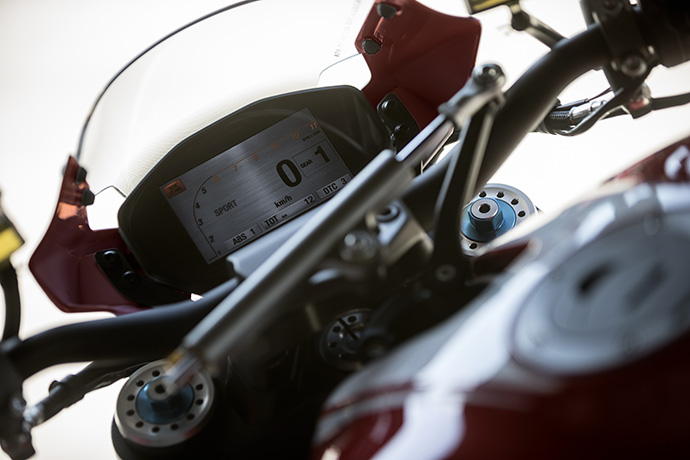
From the fuelling side of things, while absolutely ringing the Ducati’s neck, I saw a 10.2L/100 displayed on the dash but, to be honest, you are not buying this bike to save money so fuel efficiency should not even be a concern.
I have honestly never ridden a naked bike that excited me as much as this one has. Maybe it was the whole setting of the Ascari circuit which complements the bike’s capabilities, or the fact that it is just an awesome bike. The bike over-exceeded my expectations and I, for one, cannot wait to actually give it a go on the road here in sunny South Africa.
The bikes have not hit the production line yet and will only do so at the end of the year, so expected delivery date in South Africa is around March 2016 if we are lucky. The guesstimate cost of the bike will most likely be around the R260,000 mark, quite a lot of loot to ask for this kind of bike but you are getting exactly what you pay for and not just the Ducati name!